


Good morning, everyone.
Writing to you this morning from the LIRR. The theme I gave myself for my first set of fall reading is “books by people who work/ed in media.” I ordered a copy of Scribble Scribble (Nora Ephron’s collection of essays about the media that she wrote for an Esquire column) per the recommendation of Olivia Nuzzi. I went to a thrift store in East Hampton yesterday and found a copy of Save Me the Plums, by Ruth Reichl, and a book called The Potato Book, which I decided was on-theme because the forward was written by Truman Capote. Reading Capote’s description of eating a hot baked potato from a field in Sagaponack, covered in sour cream, on a chilly October morning, made me shiver in my straight-from-the-dryer $4 Chico’s sweater (that I also got from the thrift store). If you have books that you’d recommend in this category, please leave them below or shoot me an email.
Today’s newsletter includes: Chloe Malle on what newsletters she actually reads on Substack, Puck gets into the video podcast game, OpenAI hired an Unwell alumni, a scoop on David Protein’s Series B, a potential reason for Cameron Winter and Olivia Rodrigo’s dinner, Paige Paul’s New York store, and a back-to-school AI ban in New York City.
It’s free to browse and post on the Feed Me Job Board. This week, it was used by hiring teams at Ramp, Rent the Runway, and Hearst.
Guest Lecture: Chloe Malle
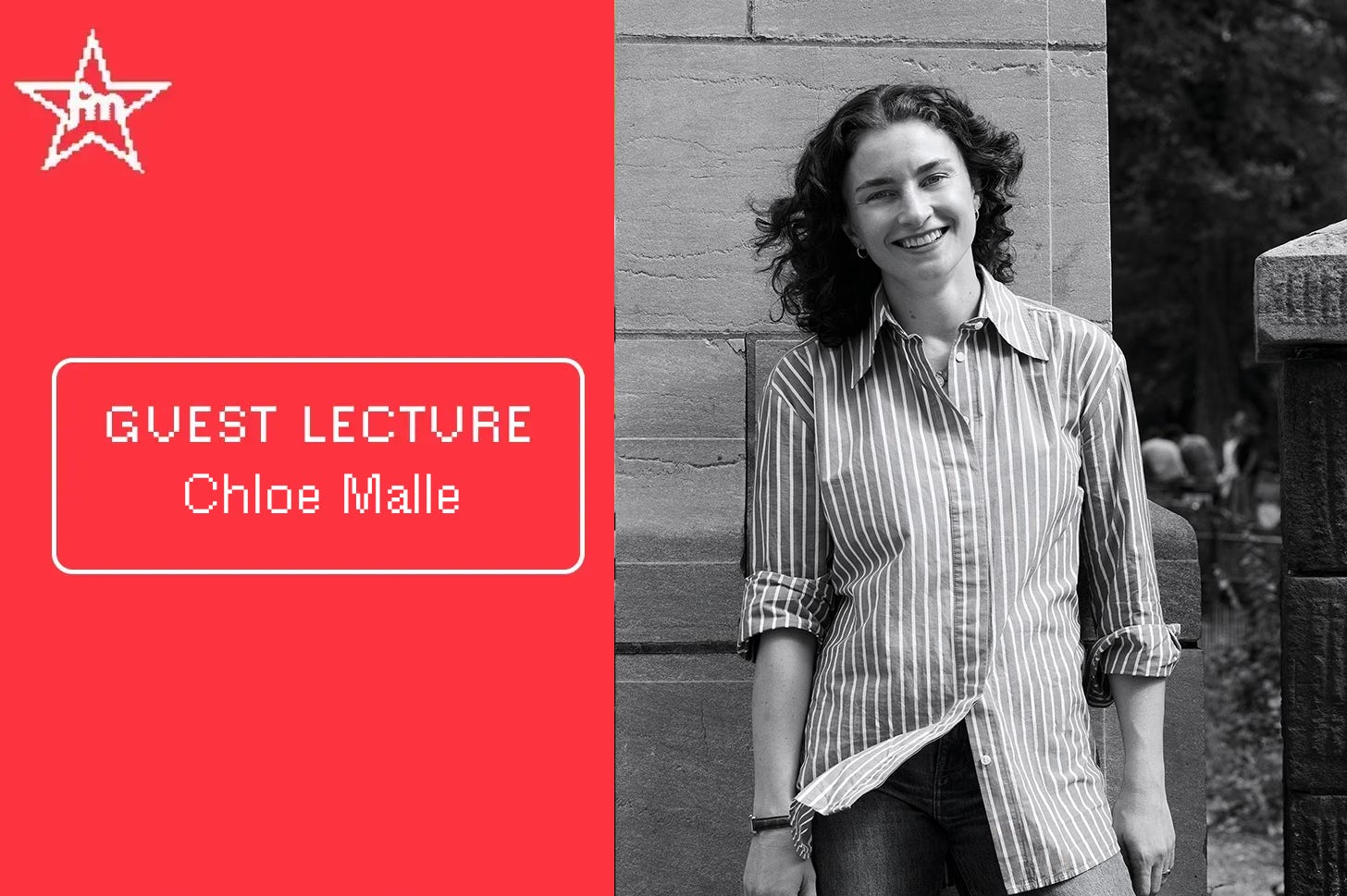
This interview is part of a Feed Me feature called Guest Lecture. In this series, I introduce you all to an expert who I’m curious about, and give paid readers an opportunity to ask them anything they want. Past guests have included Jeremy O. Harris, Brenda Hashtag, and Recho Omondi.
This week Chloe Malle, Vogue’s Head of Editorial Content, answers your questions about running a magazine in 2026, what newsletters she reads on Substack, how she thinks about the role print plays today, and what she’d wear to dinner if “not a soul” would care.
“How do you see the future of print at your company? Lifestyle journalism (including fashion) has really faced increasing competition from social media, blogs, YouTube, etc., and people have been talking about the “death of magazines” for a long time. At the same time, there is still a strong appetite for news, and some news organizations have managed to build very successful business models through things like paid subscriptions. What do you think the future looks like for lifestyle journalism? (More events? More opportunities to meet and engage with readers? Or is there even a future for lifestyle journalism??)” - Emelie
I actually think it’s a golden age for telling stories, people are hungry for narrative and point of view and now they can consume them in so many different formats, we need to be fluent in all of them. Print is still incredibly important to Vogue, but I want each issue to feel meaningful and collectible–my goal is that if someone buys Vogue at the airport to read on a flight, they’ll think twice before leaving it on the plane because the issue feels like something you want to keep (both physically—we’ve made the paper heavier—and editorially).
A big part of the future is also building a deeper, stronger connection with our audience, whether that’s through our book club, subscriber events, The Run Through podcast, social media, or by encouraging our writers and editors to lean into their own idiosyncratic and niche passions such as birdwatching or photographing a group of appealing arborists in Central Park.
It’s been really exciting to see The Run Through grow in particular. The show is a great example of how our different platforms speak to each other: a print story will come to life with a podcast interview, that interview will live on YouTube, and we’ll run clips across social. I love co-hosting with Chioma [Nnadi] and Nicole [Phelps], and getting to involve some of our other editors and writers too.
“This is SO fun! I’ve been a big fan of Chloe’s newsletter, Malle Wear. One of the things I love about it is how relatable it is - like her talking about her kids and sharing pictures from family vacations. I’m really curious about her strategy - Vogue has always been the pinnacle of ‘can’t sit with us’ vibes, but is she trying to make Vogue more relatable?” - Michelle
Thank you Michelle! I am so happy with how readers have been responding to Malle Wear! I think every editor—at any title—brings their own personality and point of view to the role, and that the most effective way to lead is to be as true to yourself as possible because people smell a rat otherwise.
People ask about this a lot—“how can Vogue stay aspirational if you are making it more relatable?”—but I actually don’t find those two qualities to be in competition. I remember reading the 2003 issue of Vogue featuring the Grace Coddington-Annie Leibovitz-Alice in Wonderland fantasy with Natalia Vodianova and being totally transported, and then a few pages later reading a reported piece on how T-shirts were the chicest Christmas gift of the season. I want Vogue to embrace whimsy and fantasy but I also want people to connect to it in a variety of ways, whether that is me mentioning seeing Minions & Monsters with my children in Malle Wear or Tyler Mitchell and Carlos Nazario describing their epic fashion shoot across Texas on the podcast. Vogue will remain aspirational, but I always want audiences to feel warmly welcomed into its pages. And I’ve always been interested in having a dialogue with our readers – what fun is it if you can’t?
I want there to be fashion, of course, but also culture, lifestyle, and ideas. I often think of longtime Vogue editor Edna Woolman Chase’s edict that Vogue presented “the outward and visible graces of a civilized way of life, the arts of gracious living.” What that meant to her in the ’40s and ’50s is likely quite different from what it means to me, but to me that confirms why we commission an illustrated series of NYC chefs’ favorite farmers’ market vendors to celebrate the 50th anniversary of the NYC Greenmarket or photograph the beach bags of the season with our favorite new novels or feature the bubblegum pink Mario Buatta-inspired interiors of the LA home of our sex columnist Eileen Kelly. It’s also important to me that Vogue has a wry sense of humor about what we do.
We are the fashion authority, but fashion is better–I believe–when not taken too seriously. Our team has been bitten by the scarf dressing bug inspired by Celine’s fall collection. In addition to a variety of trend and shopping stories, we enlisted a beautiful Afghan hound, Samantha, to model the many ways you can style silk scarves for this year’s installment of Dogue [Vogue’s dog-themed edition].