



Good afternoon, everyone. Letter is free today because I’m in the city of love and feeling generous. I’m writing this to you from behind a plate of couscous at Chez Omar.
Last night I finally went to Bistrot des Tournelles after at least a dozen Feed Me readers told me to go. If you can’t get a reservation — and therefore the opportunity to take a photo of Beef stew à la Provençale on one of their signature plates — you can buy a plate from their online store for €45. I refreshed their reservation page the night before enough times that a 7 p.m. reservation ✨appeared ✨ .
I went to the Balenciaga show earlier today, and sat next to Becky Malinsky. While eating tomato soup with bread and butter in my hotel lobby after the show, I kept zooming in on the elastic waistband on this look. Ready to wear, indeed!
Today’s newsletter includes: The latest event format of choice is movie screenings, a new gossip newsletter for VCs, Cherry Lane Theater is becoming a summit venue, Miami is about to get an influx of 18-year-old nerds, there’s a protein shortage because of your crazy eating habits, a Goldman employee-turned-influencer launched a line of sexy workwear, and Teddy Kim interviewed Jon Dieringer, the founder of Screen Slate.
There is a new Expense Account episode today, presented by Poshmark. Use code FEEDME when you sign up to get $10 off your first purchase.
“In the beginning I felt no one really respected or cared about what I was doing. Now, it’s a central part of these theaters’ publicity and marketing.” By Teddy Kim.
Stay Tuned is a Feed Me guest column about film and entertainment, written by Teddy Kim. Today, he interviewed Screen Slate's Jon Dieringer about vibe-coded clones of his site, the millions of dollars in ticket sales he never sees, and the new site he's building.
Back in August, as rogue AI-agent swarms were breaking out of their sandboxes and hacking companies, I saw a more niche controversy bubbling up on my timeline. Someone had vibe coded a site aggregating all the repertory cinema screenings in NYC. Like many, my first thought was, “Isn’t this just Screen Slate?” For those who don’t know, Screen Slate is a beloved indie cinema site that’s been aggregating rep screenings and publishing film writing since 2011. Even before this, I’d noticed new screening aggregators popping up, some on the more vibe-coded side and others, like Paradiso, that appeared more thoughtfully designed.
The whole phenomenon, to me, brings up questions about not just NYC film screenings but also AI and the value of effort, as well as a kind of digital demographic change. Around the same time that people were talking about the Big 10-ification of NYC, it seemed like we were seeing something similar play out in the clash between film-loving newcomers and, even more than “New Yorker,” a jealously gatekept subset of that identity: New York cinephile.
It all reminded me of how AI-bot-scraping brought down the movie data site The Numbers, and made me wonder if there’s a similar tragedy of the commons down the road here. I love the energy and instinct to build new things around what you love, but when does it make sense to build something new and when should you learn about and contribute to what already exists?
I noticed that Jon Dieringer, Screen Slate founder, had seen the new vibe-coded imitator as well so I wanted get his thoughts on the reality of living in a world where someone can, with AI, replicate in a few days the core functionality of a decade-plus long passion project:
TK: This whole thing struck me as an interesting way of looking at AI through the prism of Screen Slate. Anybody can now scrape the data, whip together a basic site, and say, “Here you go.” What do you make of all these vibe-coded imitators and the fact that anybody can imitate some core function of the site in a couple hours?
JD: It’s been really eye-opening. For years I’d get emails from people saying, “I want to start something similar. How do you do it?” And the secret is that there is no secret. It’s just really hard work.
It takes a lot of care. There are so many decisions that are invisible or easy to take for granted about the way we present things. Whether people detect them or not, that feeling of being really involved in and responsive to the community comes across in Screen Slate.
But all of a sudden earlier this year things started popping up in other cities and in New York. It took me a second to realize, “Oh, this is vibe coding. This is AI.”
Someone in London did a near-exact clone, which made me wonder how long it would take me to recreate Screen Slate from scratch. I did it in a day or two. It had bugs and it was a little janky, but I was like, “Wow, that’s kind of crazy.”
But a lot of what has gone into Screen Slate is thinking through the data model, what information is important to capture, and the way we present it. A lot of it’s resistant to scraping and AI.
Citizen Kane showing at a mainstream art-house cinema is easy to ingest. But when it’s Citizen Kane screening as part of a specific series with rare short films that are all on different formats, with an introduction by this person at one showtime but not the other, automatic ingestion gets really difficult.
Or Anthology Film Archives might do an evening of rare 16mm films by an avant-garde artist. A mainstream aggregator might capture the top-level program title, but not the granular details of the actual films and formats. Controlled film title databases also obliterate a lot of nuance when it comes to alternate versions, directors cuts, video, and overlooked films, all of which are what make moviegoing in a big city unique and exciting.
The other thing is keeping your ear to the ground: Instagram flyers, physical flyers, things that don’t even have a website or a regular film program.
Ultimately, you really have to be a member of a film-going community to capture that stuff. You have to think like an audience member and a curator to understand what’s important to capture.
There are definitely ways AI can help, but building something meaningful is always going to require effort. And relationships. That’s based on trust, which comes from being present in the scene.
TK: Let’s back up. How did Screen Slate get started?
JD: I moved here in 2009 after a summer working in LA, and I was still pretty recently out of college. I didn’t really feel like I fit in Los Angeles, but when I moved to New York, I just knew this was the city where I wanted to stay for the rest of my life. I loved the film culture, but I was kind of shocked that there was no central resource where you could see everything that was happening.
TK: What was the closest thing back then?
JD: The Village Voice still existed, both in print and online. And there was Time Out New York. But neither was comprehensive enough that you could pick it up and know everything that was happening.
The other thing happening around that time was a lot of interesting DIY activity that I would almost compare to DIY show spaces and music: underground screenings in ad hoc or pop-up or artist-run venues. A big one was Spectacle in Williamsburg, which I ended up becoming one of the initial volunteers at, and where I programmed hundreds of screenings.
So I wanted to create something that aggregated all of that, from highbrow rep houses like Film at Lincoln Center and MoMA and Film Forum to experimental and underground venues and one-off video art shows and microcinemas, and put them in a place where the only hierarchy is the alphabet. Not necessarily colored by sponsorship.
Some days we feature some totally esoteric experimental film, and then the next day it’s Cliffhanger or something like that. I just think it’s fun to represent the full spectrum of moving-image culture in New York.
I was trying to learn how to code, but I realized if I didn’t just put something online, I could be trying to learn forever. So I essentially created a WordPress blog and manually typed out all of the listings every day by myself.
Over time it really snowballed. My childhood best friend, Patrick Dahl, started writing more thoughtful pieces, more writers got involved, and eventually cinemas were reaching out to me asking when their schedules would be updated on the site. That gave me the in to say, “Hey, if I gave you a login and password, would you be down to manage them?”
In the beginning, I felt no one really respected or cared about what I was doing. Occasionally I would try to get into a press screening and they were just like, “Who are you?” And now it’s a central part of these theaters’ publicity and marketing to ensure their listings are on Screen Slate and up-to-date.
TK: You just held a gala that was hosted by big names like Josh Safdie, Ari Aster, and John Wilson. When did you become aware these people were reading Screen Slate?
What’s funny is they’ve been reading it since before they were big names. Greta Gerwig would email me random questions about stuff before she even directed Lady Bird, like, “Why aren’t you in LA?” I know John through Spectacle.
I’ve spoken to a number of filmmakers who told me Josh signed them up for Screen Slate. A lot of these people came up from no-budget filmmaking and probably remember when Screen Slate was one of the few places covering their screenings alongside more mainstream ones.
TK: Was there a moment when you realized people had started to pay attention?
A couple years ago, we received the Film Heritage Award from the National Society of Film Critics. The critic A.S. Hamrah was really instrumental in that. And then this year the New York Film Critics Circle gave us a very similar, very prestigious award. I got to give a speech in front of PTA and Benicio del Toro.
And being able to pull off the gala, and just the fact that people were so willing to be part of it without any arm twisting, that felt like another moment of recognition.
TK: It was a great gala. Numbers-wise, how many email subscribers do you have now?
JD: It’s 15,000 on the daily email, and monthly visits are probably around 100,000. But what’s interesting is that we’ve played the long game in terms of cultivating a quality audience.
We’ve never done clickbaity or engagement-baiting stuff to juice our stats. So it’s all people who are really committed to going to see films. Maybe Screen Slate doesn’t have millions of readers, but if you only have a 200-seat auditorium, the 15,000 people reading it every day are enough. They’re easily going to pack that out.
Especially for the theaters that monitor their traffic, they see how much comes from Screen Slate. I can’t see the conversion rate in terms of which clicks translate into ticket sales, but I would estimate it’s probably in the millions of dollars of ticketing revenue a year for art-house cinemas that flows through Screen Slate.
TK: The site is referring millions of dollars a year in ticket sales?
JD: We’re referring about half a million clicks to ticketing pages a year. If you figure $17 a ticket, and 25% of people… I would have to do the math. Plus concessions and memberships and stuff.
TK: Do you see any of it? Are you guys financially supported by that?
JD: No. The thing that is really important about Screen Slate is that it’s preserving a record of everything that’s screening. If you’re a film student 20 years from now and you want to study this moment in New York City film exhibition, you can rely on Screen Slate for being reasonably comprehensive and accurate, and there isn’t really an alternative, since a lot of venues have deleted old information from their websites, and you can’t even retrieve it from WayBack Machine without the links Screen Slate has.
So thinking through monetization, if I were to say, “Can we get a dollar for every ticket sold?” what happens if a theater says no? Am I going to compromise the integrity of the service? Then it’s less useful for readers and abdicates its responsibility to create a record of cultural life in New York City.
So it’s a bit of an honor system. We have Screen Slate Recommends sponsored emails and stuff like that, and it’s nice when people kick back what they can in the way that their institution’s budget will allow. But it’s very vibe-based.
TK: Speaking of vibes, let’s go back to the vibe-coding. Does it make what you’re doing less sustainable if people start going to those other sites instead?
JD: Yeah, it does trouble me. Are we going to head for a society in which everything just becomes 80% good, or a facsimile of good?
We’re also in this moment where millennials are kind of hitting their Facebook boomer phase. Ten or 15 years ago you’d see boomers sharing some fake, illegitimate website and wonder how they didn’t realize it. I see a lot of my peers now interacting with AI content and they seem not to realize it.
There are pretty much entirely AI-generated Instagram accounts whose most popular posts are often anti-AI posts. People respond to them like, “Yeah, take that A24,” but they’re responding to AI-generated quasi-editorial posts that are not rooted in any actual publication and have not actually passed any human review. People understand that niche is good for engagement, and AI can target niches.
It’s this cynical cycle of AI engagement baiting off anti-AI sentiment. That level of AI psychosis is going to come for all of us, whether we’re using it or not, because the cloak of reality distortion is going to cover us all.
TK: Some of these new tools are proud of aggregating everything in one place. One of the things that differentiates you is the curation. How do you decide what gets in?
JD: Sometimes people are like, “Are you beefing with MoMA?” because one showtime isn’t listed. I’m like, “We’re not beefing with MoMA. They just didn’t add something.” Dave Kehr, one of the curators there, uses Screen Slate a lot, and he told me he once went to something at the wrong time at his own museum because he saw it on Screen Slate.
From the beginning, that was an interesting parameter to think through: What is this actually going to list? Originally, back in 2011, I wondered if I should only list things on 35mm. But I was really interested in microcinemas and digital media art too. If you only limit it to film, you’re eliminating so much rich cultural material. So I settled on anything that’s on a single screen.
That immediately eliminates every blockbuster film, but then you get gray areas like A24, Neon, Sony Pictures Classics, or listing repertory stuff at BAM but not Backrooms. We’ve become a little lax about it. I don’t believe in total authoritarian enforcement of really any rule about anything, let alone movie listings.
TK: But you’re unavoidably deciding what is and isn’t important. You don’t want to be the decider, but you’ve become one of them.
JD: Yeah, it is a bit of an uncomfortable role. I started it as a literally no-budget DIY thing, and it’s progressed over 15 years to be a vaguely semi-budgeted DIY thing. To me, it’s never really left those DIY roots. But externally, maybe there are people who see it as a gatekeeper. That’s difficult to negotiate. And I kind of wonder… I am building a new site, by the way.
TK: Is that breaking news?
JD: That is kind of breaking news, yeah. I don’t know how much I should share, but hopefully soon. I already have a lot of test users. One of the things it has is the ability to mute certain theaters, basically filtering them out by default. People can have user accounts, and I’m wondering if that’s a reason to maybe cast a wider net, because people can just turn off a theater if they don’t want to see it.
But this is the challenge we’re talking about. I don’t want to be the person who determines what is and isn’t important. At the same time, these curatorial guardrails are important, because you get overwhelmed by choice, and then you’re just a no-budget Fandango. I’m not trying to run Fandango as a part-time, quasi-volunteer worker.
TK: Are you thinking of expanding to a new city? I was curious why you aren’t in LA.
JD: The new site is built around multi-city functionality. But you really need people running the show who are rooted in the community. I could build scripts for every theater in LA and ingest their listings, but to capture the richness of the events and the off-the-beaten-path or one-off things, you need people who are present and who care.
The real reason for anything we don’t do that we obviously should do is just lack of money. I want to cover more and provide more services for everyone, but we would need more support to do that. I have a day job. If someone said, “I’m going to give you money to hire a full-time staff person in LA,” that would be a no-brainer.
TK: How did SF happen before LA, then?
JD: There was a pre-vibe-coding website that was really similar that popped up, by people I was already friendly with. We were like, “Why not just combine forces?”
TK: Are you using AI to build the new site?
JD: It’s become part of everyone’s coding workflow. We’re not using AI agents within the new site or designing with AI, but I am using it to assist with coding. You really have to push back against what it gives you. You can’t accept anything at face value. It’s easy to almost get bullied into things that aren’t right. You have to go in with a real idea of what you want to achieve, certainly visually and aesthetically and conceptually.
When that What’s Playing NYC thing showed up, it was very obviously vibe-coded: unnecessary little numbers and counters on everything, language that sounds not human. If you tell AI, “Generate me a web page,” it’s going to put all kinds of weird millennial ad-copy speak all over everything. I found using it to be a bit like navigating the Backrooms.
The fun challenge is: How can this help solve certain problems or unblock features I’ve always wanted to do, while still being robust and functional and, most importantly, maintaining a sense of personality?
TK: The way people are fearful of AI tools, similar things were said when we moved from film to digital projection, right?
JD: I went to school for film preservation. I literally have a 16mm projector sitting right behind me. But when I was a volunteer at Spectacle, that kind of seven-day-a-week, volunteer-run, $5, 30-seat microcinema was really enabled by digital projection.
As much as I don’t really want to see a digital copy of The Goonies, digital projection opened a lot in terms of community spaces and alternative exhibition. So when people say, “Vibe coding is the new punk,” I’m like, I don’t think so. But I can see how changes in technology remove certain barriers.
A big trend right now is people pushing back against social media. People really want things that will help them get out of the house. To me, a sign of Screen Slate being successful is that it’s not a website trying to capture people’s time and attention. It’s a website trying to get people to go be part of the film community, meet other people, and have a real in-person experience.
I meet so many people making events apps with vibe coding. I met a guy in Greenpoint who had just been laid off from LinkedIn and was building a neighborhood events app. I could tell he was putting a lot of heart into it. You can tell the difference between one-shotting something with a giant prompt and actually spending time on it and rooting it in real, in-person relationships in your community.
TK: Maybe that’s the optimistic version. In the early web there were thousands of random sites, and discovering them felt serendipitous. Then attention got centralized onto a handful of platforms. Now it’s easy enough to make a little passion project, like a Greenpoint events app with no engineering team, that maybe we get a more diverse web again.
JD: Yeah, that’s the most optimistic, best use case. People have a bit more perspective now on the damage social media has done to our mental health, the press, and community spaces. They just want to find ways to get back to what’s happening.
TK: Screen Slate recently shared some interesting insights about what’s been historically popular at NYC repertory cinemas. Do you have any more plans to do more publicly with that database of screenings? Like looking at trends over time?
JD: For sure. We have fifteen years of screening data, and it’s interesting to track the ebb and flow of what’s considered canonical. Lizzie Borden’s Born in Flames, which is high on that list, had only screened once, on 16mm, from 2011 to about 2016. But after it was restored by Anthology Film Archives it was fervently embraced by new audiences. But there are all kinds of fun ways of looking at the data: trends in formats over time, which directors show the most, which venues have screened the most unique titles that haven’t shown at other ones. The new site allows people to see full screening histories of films and directors. I want to build some editorial around the data, and also provide retrospective looks at major past film series or venues that have closed.
TK: Last question. What do you think of all this IMAX 70mm? It’s cool to see people caring about formats, but there’s an element that feels a little too hypebeast.
JD: I have really mixed feelings about it. I went to school for film preservation, and I do think it is a truly unique and special thing to have shot a film entirely on this large format and then make prints directly from that negative.
But at a certain point it crosses into marketing hype. There’s always misinformation about film formats and what constitutes a restoration. There’s not a lot of expertise and clear information about it, which is understandable because it’s complicated.
Wait, let me show you one thing. I have a friend who’s an artist who makes conceptual bootleg artworks, and he made this VHS tape of The Odyssey…
It’s the first cam rip of a 70mm IMAX screening. He transferred it to VHS and did his own custom pan-and-scanning. It has French subtitles burned into the print. To me, this is kind of punk. The texture is so hilariously low-res that it becomes kind of beautiful. So I have only seen The Odyssey on VHS of a cam rip of a French-subtitled 70mm print.
•••
New releases this weekend: Naza, the new Gaza documentary from Yuval Abraham and Rachel Szor (No Other Land) opens wide this weekend. Atonement comes out in limited release this weekend. It’s adapted from Dexter Filkin’s 2012 New Yorker piece and Boyd Holbrook stars as the Marine who tries to reconcile with an Iraqi family years after his tour in Baghdad. Tom Cruise’s Digger also releases wide. I saw Alejandro Iñárritu’s last film, Bardo, a couple years ago at the Busan Film Festival. That movie was an interesting but sprawling mess and the early trailers of Digger didn’t inspire much confidence. People seem evenly divided on this one, with the Rotten Tomatoes score hovering around 50%. Interesting to see Warner Bros. tackle the negative reviews head on with a new cut of the trailer encouraging people to “decide for yourself.”
I’ll be doing a round-up of New York Film Festival later but some early highlights are: Jordan Firstman’s hilarious and heartwarming Club Kid. Lee Chang-dong’s typically sublime and novelistic Possible Love, which feels like a dramatic version of No Other Choice combined with the meta playfulness of a Hong Sang-soo script. In some ways, they’re very different movies, but Possible Love could share its title, along with its probing of documentary ethics, with Nathan Fielder & Lance Oppenheim’s new film, You Can See Everything, which I just saw last night. Festival director Dennis Lim and the filmmakers asked everyone in the theater to preserve the surprise of the movie for future audiences, so without saying much, I can promise it delivers the inventive insanity and discomfort that everyone is expecting, dialed up to 11. One thing to note, the movie is shot in a boxy 4:3 aspect ratio with extreme close-ups throughout that actively make you think about how Elizabeth, or Liz, Holmes is being “framed.”
Here are some other screenings I’d encourage you to check out in the coming week:
📷 Thursday 10/1 & Monday 10/5 @ Metrograph — Yi Yi (2000) — Along with A Brighter Summer Day, Edward Yang’s other magnum opus about a child and his family’s life in Taipei. Definitely worth a watch, my favorite Yang film.
🚶 Thursday 10/1 & Monday 10/5 @ Paris — Still Walking (2008) — One of the most gently moving family dramas I’ve seen. This is a personal favorite that always has me crying by the end. A modern Tokyo Story.
🍎 Saturday 10/3 @ Paris — East of Eden (2026) — Free screening of the first three episodes of Zoe Kazan’s upcoming Netflix adaptation of the Steinbeck novel. She’s introducing the 1955 film directed by her grandfather, Elia Kazan, later the same night. For everyone who also read Lonesome Dove over the past year, Kazan is doing the new adaptation of that as well. Let’s hope it’s at least half as good as the legendary 1989 miniseries adaptation starring Tommy Lee Jones and Robert Duvall.
🎱 Tuesday 10/6 @ NCPP — The Color of Money (1986) — If you’re trying to get your Tom Cruise fix this weekend, I’d recommend watching this one over Digger. On 35mm.
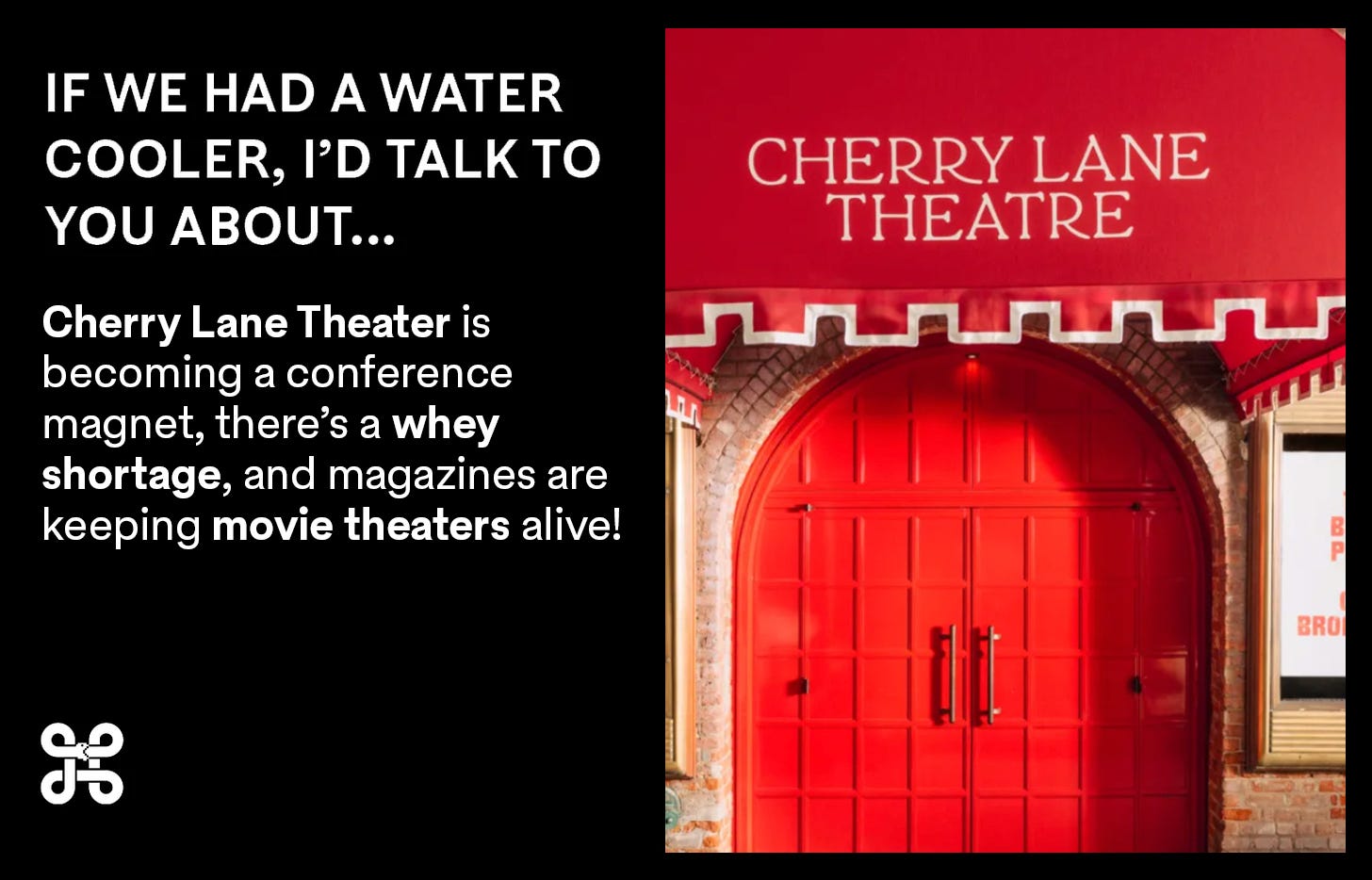
Media companies are catching on to the fact that their readers don’t want to drink free cocktails and play on their phone before a panel – they want to go to the movies. Today, Vanity Fair announced a bi-coastal (at LACMA and Cherry Lane Theater) live event series called Vanity Fair Screening Room. On-stage programming will include screenings, live recordings of Vanity Fair’s regular series and podcasts, and discussions with filmmakers and talent led by Vanity Fair journalists. A few doors down at Vogue, Chloe Malle has been hosting screenings and conversations to accompany Vogue’s Book Club (the next one is Sense and Sensibility). And The New York Times has programmed a weekend of journalism-driven films and conversations at Metrograph later this month to celebrate the paper’s 175th anniversary. I’m thrilled about all of this — big checks for movie theaters, and smart programming are always a good thing.
Once upon a time, there was a blonde woman named Danielle Pheloung who went viral on TikTok for posting the outfits that she’d wear to work at Goldman Sachs. Fast-forward two years, and that woman quit her job to become an influencer (with her twin sister Brigette) with a clothing brand called Phe Phe. I’m getting a lot of entertainment out of watching Danielle promote Phe Phe’s new workwear line, inspired by her viral office videos.
Demand for whey protein (in smoothies, in chips, in ice cream) is outpacing supply, driving shortages, and pushing up prices. This has created an opportunity for companies that are focused on using alternative sources of protein, like alfalfa leaves and eggs.
CULTURED is hosting a forum — CULTFORUM — at Cherry Lane Theater on Friday, November 6. Which means Cherry Lane Theater is becoming a forum magnet. Ana Andjelic and Sue Chan are also hosting a forum (Tasteful Summit) there this month (you can still get a ticket for $800). CULTFORUM will feature conversations with Sofia Coppola (that woman stays busy), Sarah Paulson, and Paul W. Downs and tickets are $1,200 (for less than that, you could buy a plane ticket and see her speak at London Film Festival). Here’s a question: Who is the target audience for all of these pricey day-long (weekday) summits? And why are we so eager to define taste and culture?
Ken Griffin spent $1 billion on a Miami convention center that he plans on turning into a Carnegie Mellon campus. CMU Miami will focus on “grand challenge areas” - interesting. Miami is about to get a LOT more nerds. May it work to the benefit of all parties involved.
Business Insider is launching a scoop-y VC-focused newsletter called VC Insider. It will be written by Ben Bergman (played poker with him once, he’s a shark) and Katie Roof.
1. I'd love to see how much of A24's revenue comes from Cherry Lane and sourcing out to conferences/events/etc.
2. Katie Roof is one of the OG journalists within startups/VC/tech - VC Insider is going to be real good with her co-leading the ship!
Funny how people have similar ideas! I used AI once to schedule a weekend of rep screenings, then ended up turning it into a full app to mark showtimes I want to see and track upcoming releases, favorite theaters, etc but never opened it beyond my friend group. Excited to see someone with the relationships with theaters to take a stab.